|
|
 |
|
|
 |
|
|
|
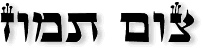
Historically, the summer has been a time of struggle and bitter woe for the Jewish people. Indeed, amid the warmth and sunshine of the season, observant Jews withdraw to a place of sad remembrance, recalling the breach of the walls of Jerusalem, the fall of the Temple, and the long exile of the Jewish people. The middle of the month of Tammuz, in particular, just after the summer solstice, is considered to be an ominous time, since it is associated with various calamities that have happened over the centuries.
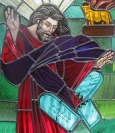
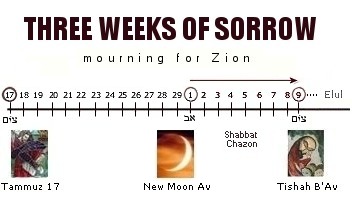
In Jewish tradition, Moses smashed the tablets on the seventeenth day of the fourth month (later called Tammuz) after he came down from Sinai and found the people worshiping the Golden Calf. This tragedy was seen as prophetic, since it was on this same date that the walls of Jerusalem were smashed by the invading armies of Nebuchadnezzar (see 2 Kings 25:2-7), an event which led to the destruction of the Temple and the exile of the people three weeks later, that is, on the ninth of Av. Today, the seventeenth of Tammuz is commemorated as a fast day (i.e., the "Fast of 4th month") that marks the beginning of the three week period of mourning for the lost vision of Zion...
|
|
|
|
 |
|
|
|
The Torah reading for the seventeenth of Tammuz is the same as all the other Jewish fast days (i.e., Exod. 32:11-14; 34:1-10) where Moses appeals to God's mercy after the sin of the Golden Calf, and how the covenant was renewed. (Note that if the 17th happens to be a Sabbath (as is the case this year), the fast is postponed to the following Sunday.) During the fast day itself, the morning service includes penitential prayers (i.e., selichot) centering on appeals for God's Compassion as revealed in the Name YHVH (Exod. 34:6-7). This is followed by prayers and recollections of Jewish suffering through the centuries:
"We have come to You, O Sovereign Molder of spirits. Because of our many iniquities, our groans have been intensified. The decrees have become severe, and many are the outcries, for on the seventeen day of Tammuz, the Tablets were smashed. We we exiled from the House You chose for us..."
Since the three week period from the 17th day of Tammuz through the 9th day of Av represents the season when the Temple was destroyed and the people were exiled from the promised land, it is called yemei bein ha-metzarim (יְמֵי בֵּין הַמְּצָרִים), "the days in the midst of distress," a phrase taken directly from the Book of Lamentations: "Judah has gone into exile, her pursuers have all overtaken her in the midst of her distresses" (i.e., bein ha-metzarim: בֵּין הַמְּצָרִים). For the ultra-Orthodox, the "Three Weeks of Sorrow" also represent a time of grieving for the horrors of the Nazi Holocaust, since had the exile from the land never occurred, the Holocaust likewise would not have occurred...
|
|
|
|
 |
|
|
|
Jewish tradition marks these three weeks as a period of national mourning, and the weekly readings from the prophets all warn the people about imminent judgment from heaven. Spiritually, the season is marked by a renewed called for teshuvah (repentance), and the weekly readings from the prophets all warn the people about imminent judgment from heaven. Indeed, the Sabbath before Tishah B'Av is named Shabbat Chazon, sometimes referred to as the "black sabbath," because the words of the prophet Isaiah are recited that harshly denounce the apostasy of the people (Isa. 1:1-17). Because this is such a somber time for the Jewish people, it is customary not to schedule weddings or other joyous events during this time of year. Indeed, among the very Orthodox, any activity that might require the recitation of the Shehecheyanu blessing is carefully avoided. Beginning on the first day of the month of Av, traditional mourning customs are practiced in anticipation of the great fast day of Tishah B'Av, when the Book of Lamentations (Megillat Eichah) is plaintively recited during the evening service.
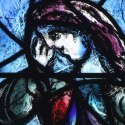
The tears of the prophet Jeremiah represent God's compassionate love for the Jewish people; the Book of Lamentations is really God's cry... God cares about the suffering of His people: b'khol tzaratam lo tzar (בְּכָל־צָרָתָם לוֹ צָר) - "In all their affliction he was afflicted" (Isa. 63:9). Even after all the horrors that befell the people of Judah due to God's disciplinary judgment, the LORD still encouraged them to seek Him again. "The faithful love of the LORD (חַסְדֵי יהוה) never ceases, and his compassions never fail. They are new every morning; great is your faithfulness" (Lam. 3:22-23). Our response to the faithful love of the LORD is teshuvah (i.e., תְּשׁוּבָה, "turning [shuv] to God"). In Modern Hebrew teshuvah means an "answer" to a shelah (שְׁאֵלָה), or a question. God's love for us is the question, and our teshuvah – our turning of the heart toward Him – is the answer. We return to the LORD when we truly acknowledge that He is our Father and our King:
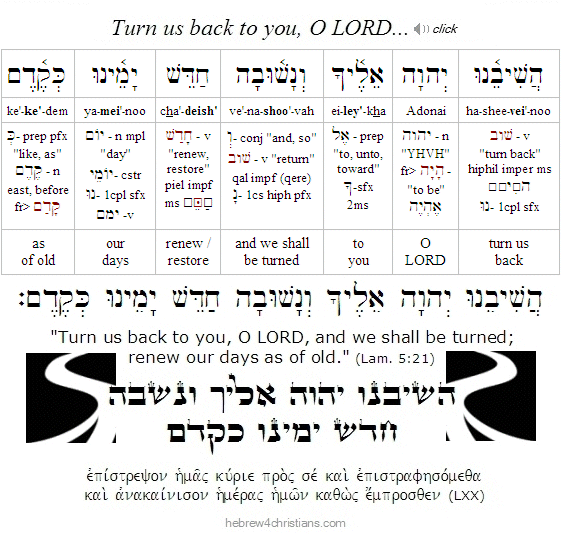
הֲשִׁיבֵנוּ יְהוָה אֵלֶיךָ וְנָשׁוּבָה
חַדֵּשׁ יָמֵינוּ כְּקֶדֶם
ha·shee·vei'·noo · Adonai · ei·ley'·kha · ve·nah·shoo'·vah
cha·deish · yah·mei'·noo · ke·ke'·dem

"Turn us back to yourself, O LORD, so that we may return to you;
renew our days as of old" (Lam. 5:21)

Hebrew Study Card
Note that the word "distress" (i.e., metzar: מֵצַר) comes from a root word (i.e., tzarah: צָרָה) that means to "make narrow or restricted" (the Yiddish word "tsuris" comes from this root), whereas the word for "deliverance" or "salvation" (i.e., yeshuah: יְשׁוּעָה) means to "make wide" or "make sufficient." These two ideas can be seen in a verse from the Psalms: "Out of my distress (מִן־הַמֵּצַר) I called on the LORD; the LORD answered me and set me in a wide open place" (Psalm 118:5). Among other things, deliverance (salvation) is always a transition from bondage to freedom...
|
|
|
|
The Five Tragedies...
|
|
|
|
The Mishnah (Tractate Ta'anit 4:3) lists five specific tragedies that are all said to have occured on the 17th of Tammuz:
|
|
|
|
- The tablets upon which the Ten Commandments were written were broken on this day when Moses came down from Sinai and found the Jews worshipping the golden calf.
- The Tamid (daily) sacrifice was discontinued on this day shortly before the destruction of the first Bet HaMikdash (Temple) because Jerusalem was under a state of siege by the Babylonians and they were unable to get the necessary animals for the sacrifices.
- Jerusalem's city walls were breached by the Romans (under Titus) before the destruction of the second Bet HaMikdash.
|
|
|
|
|
|
- King Manasseh, one of the worst of the Jewish kings, had an idol placed in the Holy Sanctuary of the Temple on this date (2 Kings 21:7).
- The Torah was burnt on this day by Apustemus, a Greek oppressor who served Antiochus Epiphanes.
|
|
|
|
More Recent Tragedies...
|
|
|
|
In addition to the Mishnah's list of tragedies, there are five more recent tragedies that are said to have befallen the Jewish people on Tammuz 17:
- In 1239, Pope Gregory IX ordered the confiscation of all manuscripts of the Talmud.
- In 1391, more than 4,000 Spanish Jews were killed in Toledo and Jaen, Spain.
- In 1559 the Jewish Quarter of Prague was burned and looted.
- In 1944, the entire population of the Kovno ghetto was sent to the death camps.
- In 1970, Libya ordered the confiscation of all Jewish property.
The Mishnah associates the seventeenth of Tammuz as the "Fast of the Fourth Month," mentioned by the prophet Zechariah (Zech. 8:19). According to the prophet, when the Mashiach Yeshua returns (may it be speedily in our time), Shivah Asar B'Tammuz will turn into a day full of "gladness and cheerful feasts."
|
|
|
|
There are four fast days (tzomot) on the Jewish calendar, based on Zechariah 8:19. Each of these fast days is related to some aspect of the loss of the Jewish Temple. The sages reckoned the months based on Nisan as the first month, and therefore identified the four fasts as follows:
|
|
|
|
Two of these fast days, the 4th and the 5th fast, occur during the "Three Weeks of Sorrow," that is, during the period of time from the breach of the walls of Jerusalem by Nebuchadnezzar to the destruction of the Temple on Tishah B'Av.
|
|
|
|
|
|
|
|
|
|
|
|
 |
|
|
|
The First Nine Days of Av

The Talmud says, "When the month of Av begins, we reduce our joy" (Taanit 26b). This is the exact opposite of the month of Adar, which is full of joyous anticipation. In Jewish tradition, beginning with the new moon of the 5th month (i.e., Rosh Chodesh Av), more serious reflection is given in preparation of the solemn day of the ninth of Av. During this time, luxuries are carefully restricted and many common actions (such as washing clothes, getting haircuts, wearing new clothes, etc.) are discouraged. In fact, mourning customs are traditionally practiced in anticipation of the great fast day of Tishah B'Av, when we recall the destruction of the Holy Temple and listen as the Book of Lamentations (Megillat Eichah) is plaintively recited during the evening service....
In short, the "Three Weeks of Sorrow" - culminating in the solemn day of Tishah B'Av - represent the saddest and most solemn days of the entire Jewish calendar, even more than the High Holidays and Yom Kippur. During this season great emphasis is placed on the need for repentance and for the salvation of the Jewish people....
A Parable for the Season
A mashal (parable) from Hassidic tradition speaks of this season... Rabbi Baruch of Mezibush (a grandson of the Baal Shem Tov) once found his young son crying. "And why are you crying?" he asked. The boy replied: "My friends and I were playing 'hide and seek.' When it came my turn to hide, I hid but after a long time in hiding I realized that they stopped looking for me... they forgot all about me," the child lamented. Rabbi Baruch calmed his child and then said to the others, "And is this not precisely what God cries about? He hid from us - as a result of our sins - but the purpose of His hiding is so that we shall search and seek Him. As it is written, if we search we will find Him (Deut. 4:29; Jer. 29:13). But, like the child, we stop looking for Him..."
|
|
|
Hebrew for Christians
Copyright © John J. Parsons
All rights reserved.
|
|
|
|
 |
|
|
|
|
|
|