|
Q

(Note: because of common English transliteration conventions, there is some duplication between "Q" entries and "K" entries. If you do not find the word you are looking for, please check under the letter K.)
Qabbalah

(kab-BA-lah) n. Kabbalah [קַבָּלָה]. Qabbalah, Cabbalah, and other spellings. "Reception; Acceptance." The Kabbalah codifies Jewish mystical teachings from the 13th century and therefore is mainly a Jewish variety of occultic medievalism, though it has roots back in the writings of Simeon bar Yochai (2nd century AD). The Jewish mystical doctrine is distinguished by its theory of ten creative forces (Ten Sefirot) that intervene between the infinite, unknowable God (Ein Sof) and the created world. Through these emanations God sustains and rules the universe, and it is by influencing them that humans cause God to send to Earth forces of compassion (masculine, right side) or judgment (feminine, left side).
A sefirah (pl. sefirot) is a channel of divine energy or life-force. In the process of creation an intermediate stage was emanated from God's infinite light to create what we experience as finite reality. These channels are called the Ten Sefirot or Ten Divine Emanations which are the basic terms and concepts of the inner wisdom of the Torah which is called Kabbalah.
The Ten Sefirot are:
- Keter - Crown; Divine Plan; God's Self-Consciousness
- Chochmah - Wisdom; Yesh me'ayin - being from nothingness (ex nihilo)
- Binah - Understanding; revelation as outworking of love
- Chesed - Kindness; everlasting love
- Gevurah - Strength; intentionality
- Tiferet - Beauty in the universe
- Netzach - Victory; resurrection
- Hod - Awe; surrender
- Yesod - Foundation; 1st principles of human knowledge
- Malkhut - Kingdom; physical revelation in space-time
Rabbi Isaac Luria substitutes the sefirah Keter with Da'at (knowledge), which is then said to be the mystical state of unity of the 10 Sephirot, sometimes called the Tree of Life).
Qabbalat Shabbat

(kab-ba-LAHT shab-BAHT) n. n. Kabbalat Shabbat [קַבָּלַת שַׁבָּת]. Qabbalat Shabbat. Welcoming of the Shabbat. A special ritual designed to welcome Shabbat that sometimes involves special preparations, most of which included the theme that Shabbat was the Bride of Israel and the Shekhinah comes to the Jewish community during Shabbat. Also the opening service on Friday evening preceding the Ma'ariv service.
Qadashim

(kah-dah-SHEEM) n. pl. Kadashim; Holy things; consecrated things; sacrifices.
Qaddish

(KAHD-deesh) n. Kaddish [קַדִּישׁ]; Doxology glorifying God's Name; prayer said for the dead. An Aramaic prayer recited for the deceased, up to a year following the burial, on the anniversary of the death, and at some memorial services. This prayer is said for members of one's immediate family. Versions of the Kaddish are also said at transitions in the prayer service, but are not used as prayers for the deceased. Traditionally a minyan is required for Kaddish. Kaddish means "May His Great Name be Sanctified."
Qadesh et HaShem

(ka-DAYSH et hash-SHEM) n. To sanctify the Name of God by noble deeds or by martyrdom.
Qadosh

(ka-DOHSH) n. / adj. Saint; holy; sacred. Kedoshim is the plural form.
Qehillah

(ka-hal / ke-heel-LAH) n. Assembly; Community; Congregation; the construct form is kehillat, as in Kehillat Israel.
Qamets / Kamets

(ka-MAYTZ) n. Qamets; (Long) vowel of the "A-Class" with a sound of "ah."
Qanna

(kan-NA') adj. Jealous (Ex. 20:5).
Qaraite

(KAH-raH-'ee) n. Karaite; Karaism; Member of a Jewish sect that rejects Rabbinical / Talmudic interpretation of the Tanakh. A devotee of the written law, from kara, the reading, which means the Torah. A movement arising in the eighth century which denied the authenticity and therefore the force of the common law in the Talmud and its subsequent rabbinic jurists. Karaism in time evolved its own common law, with variations from the main tradition. There are more than 30,000 Karaites (Qaraite) in Israel and 10,000 to 20,000 in Russia, USA, and Europe.
Qedushah

(ke-doo-SHAH) n. Sanctification; holiness; The Kedushah is also a prayer (requiring a minyan) that repeats the "Holy, Holy, Holy..." verses in the Tanakh.
Qehillat-Kedoshah
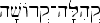
(ke-heel-LAHT ke-doh-SHAH) n. A Jewish Community.
Qere / Kere

(ke-RAY oo-khe-TEEV) Qere means "what is to be read" and refers to a margin note in the Masoretic text. Whenever a scribe felt that the text he was copying was not right, he would not change the text he was copying, but instead wrote a note in the margin. The margin note is called the "Qere" (pronounced "ke-RAY"), and the actual text is called the "Ketiv" (pronounced "keh-TEEV"). "Ketiv" basically means "to be written" (ie. what should be copied to preserve accuracy), and "Qere" basically means "to be read" (ie. what to use instead when reading the text aloud). Qere ukhetiv therefore refers to these variants. The Masorah indicates when to omit reading a word that is written and substitute it with what is read.
In short, Ketiv refers to the actual text of Scripture, and Qere refers to a scribal margin note. There are hundreds of Ketiv/Qere pairs in the Masoretic text. These pairs come in several "flavors". Some are synonymous in meaning, but sound differently. Some sound the same, but have different meanings. Some are different both in meaning and sound. Some are very similar in both meaning and sound.
Qeriat HaTorah

(ke-ree-AT hat-TOH-rah) n. Torah Reading. Public reading of Torah at the synagogue.
Qeriah

(kree-AH) n. The mourning custom of tearing a garment (or cutting a black ribbon worn on one's clothes) as a sign of grief. Hebrew for "rending" (2 Sam. 13:31).
Whom among us has not experienced loss? What do we do with our grief of heart? The ancient Jewish custom of keriah (קְרִיעָה), the tearing of our clothes to express grief, is to be performed while standing up. The sages say this is to teach that even in our time of consternation and protest over loss -- in our repulsion from what God sometimes brings our way -- we are to be upright, we are to meet all sorrow while standing upright. We must accept life on God's terms and continue to trust God in our times of darkness. Even in moments of inner heartache we keep faith in God's promises for good. May God "grant us the serenity to accept the things we cannot change, the courage to change the things we can, and the wisdom to know the difference" (Job 1:21).
Qeriat Shema

(ke-ree-AT she-MAH) n. Keriat Shema. The recitation of the Shema (Deut 6:4-9; 11:31-21; and Num. 15:37-41).
Qibbutz

(keeb-BOOTS) n. Kibbutz. Gathering; collection; group; collective; a collective farm; a community in Israel based on communal property, in which members have no private property but share the work and the profits of some collective enterprise.
Qiddush

(keed-DOOSH) n. A prayer recited, usually over wine, on the evenings and mornings of Sabbaths and holidays. "Sanctification," and specifically the blessing over wine recited on Shabbat and holidays. Kiddush is the ritual performed on the Sabbath and festival days, consisting of a liturgical text recited over a full cup of wine which is then drunk.
Qiddush HaShem

(keed-DOOSH hash-SHEM) n. Sanctifying the Name of God; martyrdom. The opposite of this is Chilul Hashem
Qiddushin

(keed-doo-SHEEN) n. Marriage ceremony.
Qodesh HaKadoshim

(ko-daysh hak-ko-dah-SHEEM) n. The Holy of Holies. The Kodesh Hakodoshim was the inner part of the Heichal (temple).
Qof

(kof) n . Qof. 19th letter of the Hebrew alphabet having a "k" sound (as in king) or a "q" sound (as in queen). Originally represented by a pictograph of the sun on the horizon. Gematria = 100. Often transliterated using a "k" rather than a "q."
Qohelet

(ko-HE-let) n. Ecclesiastes, one of the five scrolls (part of the Ketuvim). Solomon's study of the futility and meaninglessness inherent in natural reasoning "under the sun." Read during Sukkot (Tabernacles). Kohelet means "one who assembles."
Qorban

(kohr-BAHN) n. Sacrifice; Offering; Gift. (Matt 5:23). The Hebrew word comes from the root korav meaning to "come close," specifically, to come close to God. The offering was meant to bring someone who was far near once again. Korbanot is the plural.
Qots

(kohts) n. The serif or stroke on top of a Hebrew letter. This may refer to the "tittle" Yeshua spoke of in Matt. 5:8 and Luke 16:17.
Qotso shel Yod

(koh-tsoh shel YOHD) n. phr. "The Qots of a Yod." The tiniest thing; minutia; the serif mark atop a Yod, the smallest Hebrew letter. See Kots, above.
<< Return
|